For program directors and families
Introduction
Recent advances in artificial intelligence — such as large language models (LLMs), vision-language models (VLMs), and world models — have led to rapid development of humanoid robotics. We used to program robots. Now we can teach them — show a motion, give instructions in everyday language, and let an AI model decide when to perform. Together, LLMs and robots are powerful tools.
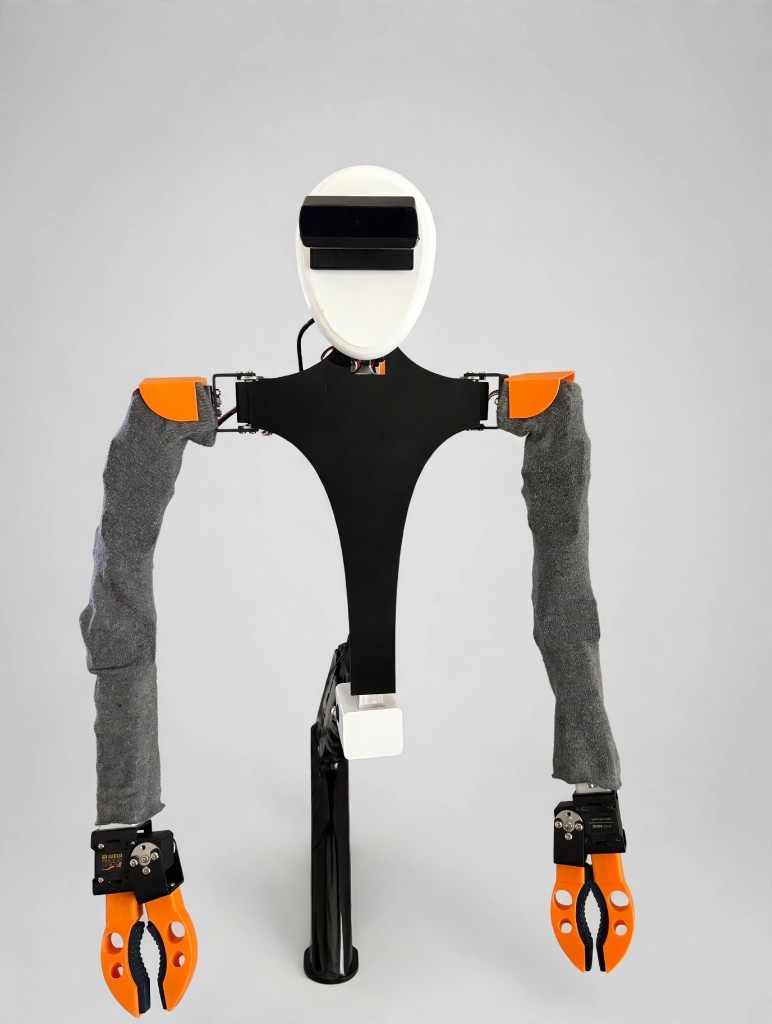
We have designed a program based on the Raven AI robotic arm and the Raven AI platform to teach students this new way of working with robots — and to become smarter users of AI. They practice treating answers as guesses, catching made-up details and false confidence, improving the question, and staying in charge. On a robot, a wrong answer that moves is a lesson they remember.
Those habits transfer. Checking a confident answer, changing the question, and staying responsible are the same skills students need with ChatGPT-style tools at home and at school.
Four ideas students leave with
- Robots can be trained, not only programmed. Show the move. Write the instruction. The arm performs.
- AI is a powerful partner, not an oracle. Learn to check, evaluate, and catch hallucinations. Do not blindly accept an AI answer.
- Problem solving happens off the screen too. Students work as a team to spot what went wrong — the arm, the cup, the setup — and fix it in the physical world, not only on the display.
- See the latest robotics, and tell hype from reality. Students work with current advances — vision, language, and a physical arm — and learn what the technology can actually do, not only what the headlines claim.
Learning objectives
- Explain the shift: from programming to training. The pour, the pick, the tic-tac-toe place were demonstrated. The LLM did not invent how to tilt the pitcher. Students can say: we trained the body; the model chooses when to use it.
- Describe how LLM + robot becomes a tool. Camera + instructions + taught motions = a machine that can greet a face with candy, sort recycling, make a mock latte, or play a turn. Powerful — and still a tool they designed.
- Treat AI as a tool, not an oracle. Models predict from this picture and this prompt. They do not know the student, the city’s recycling rules, or who won yesterday unless that evidence is in front of them.
- Catch hallucination — confident but made up. The model can sound certain while adding details that are not there: a brand on an unmarked bottle, a pour from a pitcher that is not on the table, or a tic-tac-toe move on a square that is already full. Students learn to notice that and check the real world — the same habit as catching a chatbot that makes up a source.
- Separate confidence from correctness. Sounding sure ≠ being right. Forcing “Recycle or Trash only” can make the model more certain and still wrong.
- Notice shortcuts (the easy label). Writing TRASH on a recyclable bottle often fools the model. AI grabs the obvious cue — the way an LLM can skip the hard part of a question and still sound finished.
- Ask better questions — and know that is not magic. Clearer instructions help (“sort the object, not the writing”; “only empty squares”). They do not install understanding. Prompt better, then verify.
- Tell teaching-by-copying apart from checking. A taught motion always finishes, even with an empty gripper. A smarter skill looks again and can retry. Playback and “the model said so” are not the same as verified.
- Keep a human in the loop. The model suggests; the student pair decides whether the arm may move. Stop is doing it right — like not pasting an unread AI answer into homework.
- Remember it is not a person. It doesn’t “want” to win or “understand” coffee. An LLM doesn’t care about them. It matches patterns to words and to the moves they taught.
- Work with AI as a team. Pilot runs the tool; Spotter watches the real world — then they swap.
Additional objectives for older students (about 10+)
- Teach the robot a new performance — a second candy bin, sugar and mix, a new drink on the menu. They add a demonstrated action, then change what the LLM is allowed to choose.
- Write and test the “brain” instructions — they see that they are designing the AI’s job, not waiting for the robot to become smart by itself.
- Measure when the model is right, wrong, or unsure — including that guesses about people from a single photo are often unreliable and can be unfair.
- Make a taught system more robust, not perfect. Finale: harden tic-tac-toe so it refuses illegal moves. Robust means fewer invented actions — not an unbeatable champion, and not something to trust blindly.
What this program is not
We do not claim students will write robot software, train foundation models, or “master ChatGPT.” We claim they will understand the new way robots work (teach, don’t only program) and leave harder to fool as users of modern AI.